

Overview
Princess Mononoke (1997), directed by Hayao Miyazaki and produced by Studio Ghibli, is a sweeping historical-fantasy epic set during Japan’s Muromachi period. It blends mythology, nature, industrialization, and human conflict into one of the most ambitious animated films ever made.
At its core, the film explores the balance between nature and human progress, but does so with moral complexity — no true villains, no easy answers.
1. The Curse & The Quest
The film begins when Ashitaka, a young prince, battles a boar demon corrupted by hatred and pollution. He wins, but is cursed — the curse gives him power but is slowly killing him. Told to “see with eyes unclouded by hate,” he travels west to find the source of the corruption.
This setup frames the entire movie: Ashitaka is not a hero who destroys evil but a bridge between opposing worlds.
2. Iron Town vs. The Forest
Ashitaka discovers a conflict between:
🛠 Iron Town
Led by Lady Eboshi, who:
- Gives jobs to lepers and former sex workers
- Pushes technological progress
- Expands metalworks by clearing forests
She isn’t evil — she represents human ambition, survival, and industry.
🌲 The Forest Gods
Including:
- Moro, the wolf goddess
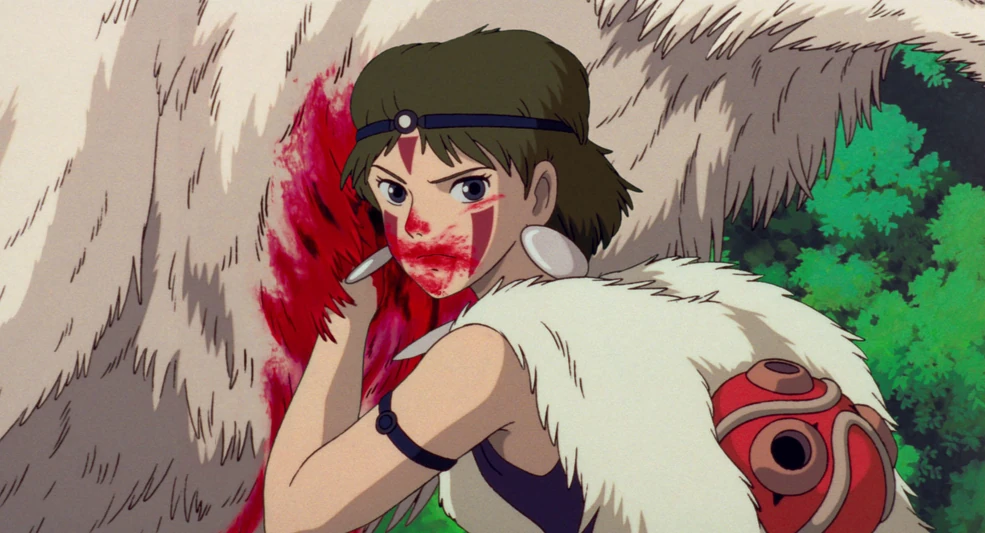
- San (Princess Mononoke), a human girl raised by wolves
- The Boar Clan and other ancient spirits
- The Forest Spirit, a god capable of both giving life and taking it away
They represent nature’s power, beauty, and vulnerability.
This conflict is not black-and-white; both sides are sympathetic and flawed.
3. San & Ashitaka: Two Worlds Colliding
San is feral, fierce, and dedicated to protecting the forest from humans. Ashitaka believes humans and nature can coexist, even when it feels impossible.
Their relationship is not a traditional romance — it’s more like two souls learning from each other while belonging to different worlds.
4. The Forest Spirit & the Cycle of Life
The climax revolves around the decapitation of the Forest Spirit, unleashing destructive chaos. When its head is returned, the spirit dies — but its death brings renewal and rebirth.
This symbolizes:
- Nature’s resilience
- The consequences of human greed
- The never-ending cycle of life
It’s one of the most powerful endings in animation history.
Major Themes
1. Humans vs. Nature (and why neither is the villain)
Miyazaki refuses to demonize humans or glorify nature. Iron Town workers are kind and hardworking. The gods of the forest are majestic but also capable of rage and destruction.
The film argues for balance, not victory.
2. Morality Without Simplification
Unlike most fantasy epics:
- No one is purely good
- No one is purely evil
- Every character has reasons for their actions
This depth is one reason the film resonates across cultures and generations.
3. The Cost of Progress
Princess Mononoke asks:
- What are we willing to sacrifice for advancement?
- Is innovation worth destroying ecosystems?
- Can industry and nature coexist without one consuming the other?
These questions feel even more relevant today.
4. Identity, Belonging & Purpose
San struggles to accept her humanity.
Ashitaka struggles to accept his mortality.
Lady Eboshi struggles to protect her people at any cost.
Each character is searching for a place in a changing world.
Why People Should Watch Princess Mononoke
1. It’s Visually Stunning
Every frame is hand-drawn with meticulous detail:
- Lush forests
- Misty mountains
- Fluid action scenes
- Mythical creatures brought to life without CGI
The animation holds up decades later.
2. It Has One of the Best Film Scores Ever
Composer Joe Hisaishi elevates the film with:
- Haunting melodies
- Ethereal choral pieces
- Emotional orchestration
The soundtrack alone is worth experiencing.
3. It Treats Viewers Like Adults (even children)
The story is complex, political, emotional, and philosophical.
It doesn’t talk down to its audience, unlike many animated films.
4. It’s Universally Relevant
Environmental destruction, industrial expansion, moral ambiguity — these issues matter more now than in 1997.
5. It’s a Masterclass in World-Building
Miyazaki creates a world where:
- Spirits feel ancient
- Cultures feel lived-in
- Conflict feels real
The universe is fantastical but deeply believable.
6. It’s One of the Greatest Animated Films Ever Made
Critics widely consider Princess Mononoke:
- A masterpiece of animation
- A milestone in storytelling
- One of Miyazaki’s crowning achievements
This film changed the landscape of global animation.
Conclusion
Princess Mononoke is more than an animated movie — it’s an emotional, philosophical, and visual epic. It challenges viewers to think about the world, explore moral gray areas, and appreciate the fragile relationship between humans and nature.
Whether you love animation, mythology, environmental themes, or simply extraordinary filmmaking, this is a film that stays with you long after the credits roll.
If you liked this article be sure to check out this one!

Leave a Reply